Showing posts with label Charles Dickens. Show all posts

Thursday, August 9, 2012

Book 138: Nicholas Nickleby by Charles Dickens.

 “When I speak of home, I speak of the place where in default of a better--those I love are gathered together; and if that place where a gypsy's tent, or a barn, I should call it by the same good name notwithstanding.”

THIS BOOK. *sigh*

I started reading this back in February as part of my little ode to Dickens on his 200th birthday. That was a mistake for a few reasons. First, I picked it up after finishing David Copperfield, which blew me away. In fact, David Copperfield remains my favorite book of 2012. It was also another lengthy title in a month where I read two other chunky books-David Copperfield and Roots-both of which were well over 800 pages. I also started the book a week before finding out I had a landed another long-term subbing position.

So you see, Nicholas Nickleby and I got off to a rough start. I managed to get to page 180 or so before setting the book down. And there is sat, languishing away on my nightstand for a couple months before I picked it back up again. It seemed to be a bit of a love/hate relationship. Once I started reading it again, I was reminded of how much I really enjoyed the story. But I also hated it a bit. I always had it lingering in the back of my mind as being something that was unfinished and dragged out.

I finally determined enough was enough and devoted myself to reading the book in the middle of July to finish it once and for all (and the fact that only parts of this post have been written until today also shows you how everything about this book seems to drag out).

So, on to discussing the actual book, now that I've dragged this all out.

Nicholas Nickleby is quite simply the story of a family down on their luck after the loss of their father/husband. With no one else to turn to, the Nicklebys seek out the help of Ralph Nickleby. Uncle Ralph supposedly comes to the rescue by seeking out employment for Nicholas and his sister. What happens after is a series of life-changing events as the Nicklebys come to terms with finding a stable life on their own.

In one word, I might describe the book as funny. There are many "Dickens Characters" throughout the entire novel. They make the book what it is, and even after I set the book aside for months, I still could picture them in my mind clearly as I finished the rest.

The first big character to come to mind is Wackford Squeers, Nicholas' first employer. Dear Wackford runs a school out in the country. He hires on Nicholas to help teach, but it is clear from the beginning that Squeers is just in education for the money and really doesn't care about the boys he takes in. A good first part of the novel takes place at the school, as Nicholas realizes what kind of abusive environment the boys live in. The Squeers family, while horrid creatures, were actually some of my favorite characters in the novel, just because of how much I hated them!

Another character that comes to mind is Smike. Orphaned when really young, Smike has been a part of Squeers' school for a long time. He isn't all that bright, but he's loyal and loving. When Nicholas flees the school (not a spoiler, as this happens fairly early on), he follows him to serve him. I was struck by how Smike was always there for Nicholas as they continued traveling and finding work to sustain them. Their friendship throughout the novel was purely genuine, and I loved seeing their interactions.

I should also mention Ralph Nickleby in passing, since he was a conniving piece to all of Nicholas' misfortunes in the beginning. You would hope, that in the event of a family member's death, your family would be there to support and love you. Ralph was anything but supportive and loving. He handed off Nicholas to the first person (Squeers) who would take him on, then seemed to brush his hands of the whole matter.  We eventually find out bits and pieces of why Ralph was such a piece of work.

Overall, I really enjoyed the story, but it paled in comparison to David Copperfield. In many ways, the two stories are similar. Both tell of young men, David and Nicholas, who are trying to work their way up in the world and become successful. David's story seemed more honest to me. While he was also surrounded by schemers, he also had people who truly supported him helping him along the way. Nicholas' story, on the other hand, seemed full of characters. And while I love a good Dickens character, they were too much throughout the entire novel. It seemed overdone...and fake in some way. I just preferred the honesty of David's story over the wild nature of Nicholas'.

But that doesn't mean it isn't a good book, because it most certainly is! It had me laughing constantly, and there were many passages that I marked. It was also a fast read (once I settled back into it) and I finished the last half in only a couple of days. It is definitely a great example of Dickens at his funniest, and of course, the social commentary was spot on. I will definitely read it again!

“Happiness is a gift and the trick is not to expect it, but to delight in it when it comes."

Monday, July 16, 2012

David Copperfield Giveaway (A Victorian Celebration).

*This was supposed to post on Friday, but because of internet issues, did not. The ending date has been adjusted*

Well, we are in the home stretch for the Victorian Celebration folks! With about 2 weeks left in July, I am wondering whether I will ever manage to finish Nicholas Nickleby and Barchester Towers-the two books I REALLY want to get done before the end of the month. Granted, this week has been rather hectic, but I really need to get in some more reading time this week!

Today I am giving away a book that is very close to my heart. I have struggled with Dickens since I was in ninth grade, but I am determined to like him. In February, I read HIS favorite work, David Copperfield, and fell in love with it. Hands down, it is the best book I have read in 2012.

Here is a little synopsis taken from Goodreads.com:

"David Copperfield is the story of a young man’s adventures on his journey from an unhappy and impoverished childhood to the discovery of his vocation as a successful novelist. Among the gloriously vivid cast of characters he encounters are his tyrannical stepfather, Mr. Murdstone; his formidable aunt, Betsey Trotwood; the eternally humble yet treacherous Uriah Heep; frivolous, enchanting Dora; and the magnificently impecunious Micawber, one of literature’s great comic creations.

In David Copperfield—the novel he described as his “favorite child”—Dickens drew revealingly on his own experiences to create one of his most exuberant and enduringly popular works, filled with tragedy and comedy in equal measure."


It is a FABULOUS book and one that I cannot recommend enough! 

When I ordered some of the new Penguin English Library editions, I immediately added this in my cart for me...and one for you! One lucky winner will win a brand new copy of Dickens' David Copperfield. To enter, read the following and comment below:
  • This giveaway will be open to any residents of the U.S. or Canada
  • You MUST be a participant of A Victorian Celebration to enter.
  • You MUST be 13 years or older
  • You do not have to follow me or subscribe to qualify
  • You MUST leave me your e-mail so that I contact you if you win
  • The winner will have 48 hours to respond or I will pick a new winner.
  • To enter, comment on this post and answer the following question: What are your reading plans for the remainder of A Victorian Celebrations?
  • The giveaway will be open until 11:59 PM on Sunday, July 22, 2012 EST.
Good luck!

Thursday, June 28, 2012

Author Focus: Charles Dickens and Giveaway (A Victorian Celebration).

Welcome to this week's Author Focus on Charles Dickens! I have already featured George Eliot and Wilkie Collins.

Anyone who has read me for awhile knows that I haven't always been the biggest fan of Dickens. In fact, I used to hate him. Granted, I wasn't really being fair to him or his work, and as I have let myself explore his life and work, I've come around.

I still like to fondly refer to Mr. Dickens as my literary arch-nemesis. I don't think he would mind...but I think he would chuckle at my prejudices against some of his work. :) But I'm here to share what I've learned about Mr. Dickens in my explorations of his life-and what a life it was!

Charles Dickens was born in 1812 to John and Elizabeth Dickens as the second of eight children. When he was relatively young, Charles was sent to school and his family was doing okay. That changed in 1824 when his father, John, was sent to debtor's prison. His wife and the younger children lived with John in the prison while the older kids found homes with relatives and family friends. At only 12 years old, Charles found employment at Warren's Blacking House to help support his family. He would often work ten or twelve hour days for minimal pay. His experiences working as a child had a lasting impact on his life and writing (Oliver Twist comes to mind).

Eventually, John inherited some money from a relative and found his way out of prison. Rather than remove their son from his place of employment right away, Elizabeth Dickens waited. Like his work experiences, this lack of care for his well-being had a significant impact on Charles. You can see evidence of his feelings towards women and mothers in many of his novels.

Charles eventually found work in a law office as a clerk. Again, his experiences working in this kind of environment impacted his writing later on in life (Bleak House and Nicholas Nickleby spring to my mind!). Charles eventually turned to a journalism career, working for various magazines for a number of years.

It was during his time working for magazines and journals that Charles began to seriously start writing. His first set of periodicals was eventually collected into a book, Sketches by Boz (Boz was a pseudonym). These sketches caught the attention of publishers Chapman and Hall, who hired Dickens to write in accompaniment to a series of illustrations done by Robert Seymour. The result was The Pickwick Papers, Dickens' first novel.

In 1836, Charles married Catherine Thomson Hogarth and continued to publish new novels in episodic form. By only releasing one portion of his new novels at a time, Dickens began to master the form of writing. Readers would wait anxiously for the next installment to be published. His fame began to rise with each new publication. As he aged, his novels also began to tackle more difficult themes-namely socioeconomic issues.

Dickens was prolific even while he was alive. He was a major voice in the era and befriended many of his contemporaries, including Wilkie Collins. Together, they wrote numerous plays and short stories. It was during one of these co-written plays that Dickens met Ellen Ternan. He fell so in love that he made the decision to leave Catherine for Ellen in 1858. Since divorce was still relatively taboo, Charles and Catherine agreed on a separation, but Charles spent the rest of his life with Ellen. Yet another Victorian writer scandal (that makes us 3 for 3!).

It was after this that Dickens began a series of reading and speaking tours. He traveled throughout Europe and the United States on his tours. It was during this time that many of his "major works" were published, including Great Expectations and A Tale of Two Cities. Many critics believe that he entered a serious mode of thinking about his writing and changes he could make in society. It what around this time that he also began some serious philanthropic work in England.

On June 9, 1865, Dickens' life took a turn. He was involved in the Staplehurst Rail Crash. It was a horrific event at the time, and Dickens was in one of the only cars that wasn't overturned. He was on board with Ellen and a few other friends when the train crashed. He spent hours attending to those who were injured or dying until further help came. He even risked going back into the train to rescue the unfinished manuscript of Our Mutual Friend.

The crash and the result changed his life. After the crash, he began to be very introspective and never seemed to fully recover to where he was before. His works took a darker turn and his health deteriorated. Charles eventually passed away on June 9, 1870-five years to the day AFTER the rail crash. He was laid to rest, against his wishes, in Poet's Corner at Westminster Abbey.

Dickens is known not only for his life and legacy, but for his popularity, characters, and enduring themes. He is one of the world's most popular authors and continues to have a lasting impression on our society and popular culture (I think we all know what a "Scrooge" is). Not only did he have humor and laughter in his works, but also depth and social commentary. I know that I have begun to look past the surface of his novels to find the deeper meaning. And while I may be coming around to his novels and style of writing, I'll always think of him as my literary arch-nemesis. :)

Dickens' complete novels include, in order of publication:
  • The Pickwick Papers
  • Oliver Twist
  • Nicholas Nickleby
  • The Old Curiosity Shop
  • Barnaby Rudge
  • Martin Chuzzlewit
  • Dombey and Son
  • David Copperfield
  • Bleak House
  • Hard Times
  • Little Dorrit
  • A Tale of Two Cities
  • Great Expectations
  • Our Mutual Friend
  • The Mystery of Edwin Drood (unfinished)
To celebrate Charles Dickens, his life, and his works, I am giving away a copy of the Dickens Bicentenary. I discussed my own copy in this post. It is a phenomenal collection, complete with inserts, photographs, and way more information about Charles than I could include in this post. To enter, read the following and comment below:
  • This giveaway is open to anyone! As long as the Book Depository delivers to your country, you can enter (I reserve the right to ship from another company if you live within the U.S.). 
  • You MUST be a participant of A Victorian Celebration to enter.
  • You MUST be 13 years or older
  • You do not have to follow me or subscribe to qualify
  • You MUST leave me your e-mail so that I contact you if you win
  • The winner will have 48 hours to respond or I will pick a new winner.
  • To enter, comment on this post with your answer to this question: What Dickens character do you think is the most memorable and why?
  • The giveaway will be open until 11:59 PM on Friday July 6, 2012 EST.
Good luck!

*Information in this post was taken from wikipedia.org and the Dickens Bicentenary*

Monday, February 27, 2012

Book 138: Initial Impressions.

“Dreams are the bright creatures of poem and legend, who sport on earth in the night season, and melt away in the first beam of the sun, which lights grim care and stern reality on their daily pilgrimage through the world," (150).

I am just around 200 pages into Nicholas Nickleby by Charles Dickens. I'm surprised at how quickly this one is going, considering it took me awhile to hit the same page number in David Copperfield, and this one is longer! But, there seems a be a drastic different in style between the two. This one appears "lighter" in tone, so perhaps that is why the pages seem to be flying by.

I'm going to be honest and say that in comparison to the other Dickens novels on my list, I know relatively nothing about this one beyond the fact that it was Dickens' third novel and that it is supposed to be funny. I rather like not knowing what's going to happen, or what his purpose is. Instead, I can "sit back" and enjoy the language and story.

The novel begins with two brothers. One, Ralph, gambles with his inheritance money and makes a fortune. His brother, the older Nicholas, marries, has two kids, and settles on his farm. When he passes, he leaves his wife and kids poor with no where to turn. In desperation, they turn to Ralph for help.

Ralph is a funny...and rather bitter old man. He agrees to help his relatives by pushing them off into the first situations he finds for them. For the son, Nicholas, they go to answer an advertisement in the paper for a teacher's assistant. They arrive to find a lovely fellow named Wackford Squeers. Now, just judging by that name you know that Nicholas is in for a treat, right? HA.

Nicholas travels with Squeers to his home and school 250 miles from London. The boys in the school are thin, wearing patched and ragged clothing, and freezing from lack of proper bedding and warmth. It is clear to Nicholas that they are mistreated and Squeers is a tyrant, but what can a guy in his situation really do? His descriptions of the boys were pretty heart-wrenching;

"There were little faces which should have been handsome, darkened with the scowl of sullen dogged suffering; there was childhood with the light of its eye quenched, its beauty gone, and its helplessness alone remaining; there were vicious-faced boys brooding, with leaden eyes, like malefactors in a jail; and there were young creatures on whom the sins of their frail parents had descended, weeping even for the mercenary nurses they had known, and lonesome even in their loneliness," (97).

The other descriptions of the beatings and meal times were equally as painful (the boys lined up for breakfast to have a wooden spoonful of food shoved in their mouths before getting a measly bowl of porridge). At first I wasn't sure what Nicholas was going to do to combat that pain, but after befriending an orphan named Smike, it seems obvious that he will eventually fight back. Which he did in heroic fashion, beating the crap out of Squeers and running away.

As for Nicholas' sister, Ralph Nickleby found her a place in a milliner's shop, but the narrative switched before I could see what happened to her.

Already 200 pages in, I know that I am going to enjoy this one. While it may not have the same depth or complexity as David Copperfield, it does seem to be touching on some similar themes-self-preservation, reliance, and making a path in a world set against your own success. There are also quite a few characters, just as in David Copperfield. The characters are all unique and crazy, with their own individual quirks. I'm looking forward to seeing where this one leads, and whether I will rank it as highly as David Copperfield.

Friday, February 24, 2012

Book 138: Nicholas Nickleby and Book Stats.

Title: Nicholas Nickleby
Author: Charles Dickens (1812-1870)

First Published: 1839 (serialized)
My Edition: Penguin Classic (seen at left)
Pages: 817

Other Works Include: The Posthumous Papers of the Pickwick Club, Oliver Twist, David Copperfield, The Old Curiousity Shop, Barnaby Rudge, A Christmas Carol, Dombey and Son, Bleak House, Hard Times, Little Dorrit, Great Expectations, A Tale of Two Cities, Our Mutual Friend

I've been wavering back and forth the last day or two about what my next read should be. I've been reading a couple of chunksters this month and the idea of going into another one has me a little unsettled, but with David Copperfield and Roots under my belt, I feel like I can tackle anything. Plus, the idea of settling into another Dickens after my recent success has me feeling all toasty inside. :)

I don't know much about this one besides the fact it was his third novel and that is supposed to be a funny one. I do like the humor I find in Dickens' novels, so I hope that's true!

Anyway, here are the posts on the other novels by Dickens I've read for this challenge, starting with my most recent posts on David Copperfield:

Book 137: David Copperfield-
  1. Book Stats
  2. Dickens is Winning Me Over
  3. Characters-Dickens at his Best
  4. Finished (A New Favorite)
Book 10: Great Expectations
  1. My Hatred of Charles Dickens
  2. Invitations and Torture
  3. Charles Dickens Made Me.
  4. The Bright Light of Manwich.
  5. Finally Finished.
Book 65: Bleak House
  1. Early Chapters.
  2. Finished.
Book 77: Oliver Twist
  1. Volume 1.
  2. Volume 2.
  3. Volume 3.
Book 88: Hard Times
  1. Classics Circuit Post (Dickens v. Austen)
A Christmas Carol (Love-not a book from my project list)

Wednesday, February 22, 2012

Book 137: Finished (A New Favorite).

I finished David Copperfield late last night. I was up until 2 in the morning, determined to finally finish it...and because I was hooked. It was worth it, except that I stayed up even longer thinking about the novel and what it had to say about life. I think it is easy for me to say that I doubt any other Dickens novel will surpass this one. I could be surprised, but I don't think that anything else Dickens has to say will reach me so deeply and change me so much.

A lot of what kept me awake until the wee hours of the morning was spurred by a comment made on this post by Donna. I had pointed out how much I loved the first line of the novel, "Whether I shall turn out to be the hero of my own life, or whether that station will be held by anybody else, these pages must show," (5). Her comment basically told me to mull that over as I read further and as I finished. I did, so thank you for pointing that out to me.

In David Copperfield, the young David undergoes many struggles and heartache before he reaches a true sense of happiness at the end. He is born to a young widow who eventually remarries a mean man. She is bullied and eventually passes, leaving David in the care of a man who hates him. Forced to work at a young age, David seems hopeless. In desperation, he runs away to an aunt he has never met, who left him the night of his birth because he wasn't a girl. Thankfully, she agrees to take him in and nurture him. This is where David gets his chance. He begins to thrive. He succeeds. And while there is still plenty of heartache in store for him as he grows older, he survives. He manages. And not because he has the faith in himself to keep going, but because of the people around him.

As I look back at the first statement, I want to change it so it applies to all of us..."Whether we will turn out to be the heroes of our own lives, or whether we will allow those who love us to hold that station, our lives and the result of our work must show."

I neared the end of the novel thinking about that. As David grows older near the end, as he begins to see the impact that others have had on his life, I think he comes to the same conclusion I did. That the people who surround us in our lives are the ones who shape us. True, some might have the drive and power to push above their circumstance, but we are all shaped in some way by those who care for us.

I think a lot of what David becomes is powered by the belief others have in him. Near the end of the novel, he finds that to be true of his best friend and "sister," Agnes. When they were young, she helped push him to believe in himself. He says near the end,

"And I am so grateful to you for it, Agnes, so bound to you, that there is no name for the affection of my heart. I want you to know, yet don't know how to tell you, that all my life long I shall look up to you, and be guided by you, as I have through darkness that is past," (709).

After finishing the novel, I realized that David's observations about Agnes were both correct and incorrect. While she did guide him through much of his life-offered support and inspiration-she is not solely responsible for the man he became. The last chapter touches a little on this, but Dickens doesn't seem to dive into the idea. Instead, he just kinds of holds it out there in hopes his readers will grasp the idea. But in that last chapter, David talks a little about the people who most influenced him. From Peggotty to Mr. Peggotty to Traddles to Steerforth to Uriah Heep to Dora and more, every character and every person mentioned influenced him. Some, like the Murdstones, were there to show him what kind of man he didn't want to be. Others, like his aunt and Peggotty, were there to show him he was of value when his world came crashing down. Others challenged his strength of character, others showed him how to be a man, and others tested his abilities to do the right thing.

In some ways, I don't think the novel is really about David Copperfield. I think it might be about the people around him...who made him who he became. It was only through these interactions and experiences that he succeeded...and that others became the heroes of his life.

Does that idea apply to us? Perhaps. I think we do have the opportunity to make our own way, but you can't argue that no one has had an influence on your life. For me, I can think of many, from my parents, to Matt, to my siblings, and my teachers. All of them, some of them mere characters for a moment, gave me something. They have all altered me in some way, changed me, molded me into who I am today. To claim that I am the hero of my life is silly. I owe my drive and passions to those who have been near me for even a moment's time. Just like David Copperfield.

I don't know how Dickens would feel about my observations on his work, and to be frank, I don't care. :) I do think he would be happy to know that I loved this book and that it will probably remain my favorite Dickens. And that I am thinking of giving Great Expectations another try. I think I "get" him now. I respect him and his work. And we share a favorite. That should mean something.

"It will be easily believed that I am fond parent to every child of my fancy, and that no one can ever love that family as dearly as I loved them. But, like many fond parents, I have in my heart of hearts a favourite child. And his name is David Copperfield," (Charles Dickens).


*Finishing this novel also means a book crossed off on 3 of my challenge lists: 2012 Victorian Challenge, 2012 Chunkster Challenge, and 2012 TBR Challenge. Go me!*

Monday, February 20, 2012

Book 137: Characters-Dickens at His Best.

I've read a few Dickens novels, but never with more excitement than my current reading of David Copperfield. I think that my own reading maturity level is finally on par with what Mr. Dickens has to offer in his work. I think I have finally set aside my own prejudices from bad reading experiences to see that yeah, all those millions of people who have read Dickens and loved him might be right. Remind me to keep this in mind as I continue teaching because I am sure that this will be great to talk about with students.

Anyway, there is one thing that Dickens excels at and that is creating and developing characters. Even in my negative experiences, I appreciated the fact that Dickens creates the most amazing characters. That continues here in David Copperfield.

You have to admire the diversity in his characters...and it also has to wow you. For a novel that spans over 700 pages (in my edition), it continually astounds me that Dickens can show the growth in multiple characters as the novel progresses forward. Of course the novel is focused on David, being that he IS the title character and all, but I'm going to ignore him for this post and focus on the other characters.

From the beginning, Dickens maintains a large number of secondary characters that wander in and out of David's life. When he is young, that is limited to the Peggotty family, as well as Mr. and Miss Murdstone and his mother. For some reason, after his mother died and he ran away, I assumed I was done with the despicable Murdstones. Imagine my surprised when they BOTH popped up again at various points. I love this description of Miss Murdstone...

"A passing thought occurred to me that Miss Murdstone, like the pocket instrument called a life-preserver, was not so much designed for the purposes of protection as assault," (329).

Buahahaha. That part had me cracking up, and it wasn't because that line was particularly funny, but because Dickens had done such a lovely job of painting Miss Murdstone beforehand! And while I hadn't encountered her in nearly 200 pages, I was again reminded of her snarly face and her manipulative ways. That just made the line come alive for me-because I knew her and could see that description fitting. And even though I really hate both of the Murdstones, I find myself wondering when they will pop back up, simply to see what kind of description Dickens paints them with.

Another of my favorite characters is Mr. Peggotty. In the beginning, I saw him as kind of a goofy uncle...which is just what he is. I didn't take him too seriously because he seemed to happy in life and circumstance (something I think really shaped young David). But when his niece, Emily, runs away, I saw a completely different side to Mr. Peggotty. And I just love him. He is so focused on protecting his family and keeping them together. When he approaches the mother of the son who took her away, he speaks with such passion...

"Hark to this, ma'am," he returned, slowly and quietly. "You know what it is to love your child. So do I. If she was a hundred times my child, I couldn't love her more. You doen't know what it is to lose your child. I do. All the heaps of riches in the wuerld would be nowt to me (if they was mine) to buy her back!" (394).

I wanted to jump and shout "YEAH" right at her face. But I couldn't and didn't.

Here is why else I love him...

"I'm a going to seek her, fur and wide. If any hurt should come to me, remember that the last words I left for her was, 'My unchanged love is with my darling child, and I forgive her!'" (398).

*sigh* That is some level of devotion.

Dickens does such a masterful job with each character that I can't even begin to explain each of them. From Steerforth's sliminess, to Mr. Micawber's weird letters, to his aunt's fear of donkeys on her grass, each character jumps off the page and comes to life. And all of them are so different! Like I said, this is a massive book, and while hundreds of pages may elapse between when David encounters a character, I never mix them up or forget them. That is a high level of skill and one that I am coming to appreciate. By making all of his characters a character, I don't forget them. I love it.

I can't wait to see what happens to each of them as I finish. I have some guesses, but I have 300 pages to go. A lot can happen! :)

Tuesday, February 14, 2012

Book 137: Dickens is winning me over.

"Whether I shall turn out to be the hero of my own life, or whether that station will be held by anybody else, these pages must show," (5). 

And so begins David Copperfield, my next foray into Dickens' writing. As I mentioned in my intro post, I haven't had the best experiences with reading his work (due to an extremely negative read of Great Expectations in high school), but I thought I would love this one.

Turns out, I am. There is something about his writing in this novel that has completely drawn me in. I don't know if it is because this is a more autobiographical piece that I admire the writing more, or if it is because I am working hard to appreciate the subtleties of his writing. Perhaps I am just developing a tolerance for his work. Or maybe, just maybe, it is because I am finally letting go of my negative impressions of Dickens and just letting the work speak for itself. Considering that the Victorians may be my favorite era, I should love Dickens! I am getting there.

It also might be that I find young David Copperfield to be a far more interesting and relate-able character than Pip (Great Expectations) or Oliver (Oliver Twist). From that first line I mentioned above, I care about him. I want young David to succeed and thrive in a world where the odds are against him.

David is born to Clara Copperfield, a young widow who seems quite naive and unsure of her own status in life. David's great-aunt, Betsy Trotwood, abandons them both the night of David's birth when she learns he is a boy. This means that David only has his mother and nurse Pegotty to raise him into a strong man. It is clear from this kind of beginning that David will struggle.

He seems to lead a very happy albeit sheltered life. He has close relationships to both women and seems to flourish under their care...until his mother is wooed by the nasty Mr. Murdstone.

This is where I felt my heart start to truly feel for David. His mother, young and blinded by her love for Mr. Murdstone, agrees to marry the jerk. Once married, Mr. Murdstone and his sister, Miss Murdstone, rule with an iron fist. They make the rules and decisions in the once happy household. They refuse to take clara's feelings and ideas into account and soon alienate poor David from his mother. Soon, David begins to feel neglected, cut off from his mother.

You have to sympathize with him, and this is truly the place where Dickens succeeds! By making Murdstone so despicable, David immediately becomes likable. I hate Mr. Murdstone right along with him! I also want to lash out and when David eventually snaps and bites Murdstone when provoked, all I could feel was a sense of justice.

Until David is sent away to Salem House, a school, after the incident. Away from home, David isn't there when his mother falls ill and eventually dies. Then he is at the mercy of those awful people. What a horrible kind of existence-to know that your future lies in the hands of two people who hate you!

So why did I sympathize so much with David and not with Pip or Oliver? Unlike the other 2 protagnonists, David feels real. He doesn't have the same whiny characteristics as Pip. And he isn't so achingly...Oliver. No, David seems to accept his lot in life. When things happen to him, he acts genuine and accepting. There aren't fake tears or complaints, but an acceptance that these things are meant to happen. He seems stronger than the other two, and while he may lack a little confidence, he continues to try to be better. That is why I love him so. And that is certainly the mark of a great writer-to make me care about a fictional little boy.

I know that Dickens is known for his characters, but this novel far outshines the others that I've read. Beyond David, there are countless others worth mentioning, but I want to read more before I say anyting about them. I am curious to see where David goes from this point in life-orphaned and in the care of despicable people. I wonder whether he'll succeed as I want him to. And I suppose I'll find out soon enough.

"The mother who lay in the grave was the mother of my infancy; the little creature in her arms was myself, as I had once been, hushed forever on her bosom," (115).

Thursday, February 9, 2012

Book 137: David Copperfield by Charles Dickens and Book Stats.

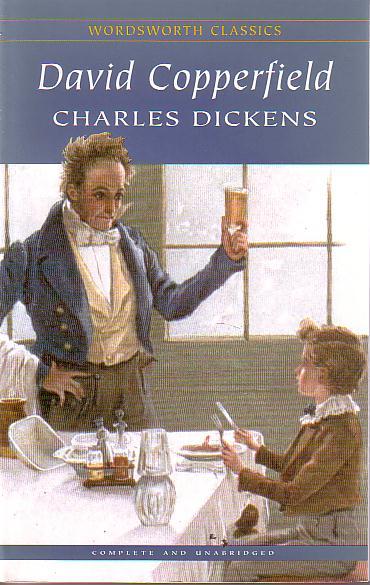
Title: David Copperfield
Author: Charles Dickens (1812-1870)

First Published: 1849-1850 (serialized)
My Edition: Wordsworth Classic (similar to the one at right-the image on mine is different, but I can't locate it online)
Pages: 737

Other Works Include: The Posthumous Papers of the Pickwick Club, Oliver Twist, Nicholas Nickleby, The Old Curiousity Shop, Barnaby Rudge, A Christmas Carol, Dombey and Son, Bleak House, Hard Times, Little Dorrit, Great Expectations, A Tale of Two Cities, Our Mutual Friend

Usually when I draft these kinds of posts, I go back to look at my other posts by the same author so I can copy in some of the information. Imagine my surprise when I realized that I hadn't done one of these stats posts for any of the Dickens I've read! I suppose I was just fortunate enough to avoid this. :)

I was supposed to get to this title last July for a readalong hosted by Adam. But, I was super busy that month and while the book was on my nightstand, I never got around to actually opening it. Oops. It seems to have all worked out, since Dickens' 200th birthday was yesterday and it seems the world has gone crazy for Charles.

I have a love/hate relationship with him, but I have become more and more intrigued by his novels. He called this one his favorite, so I am hoping I feel the same way as I dive further into it (I'm about 20 pages in right now). So many people have said they love this one, so that seems promising, right? In any case, I can't wait to be a little more knowledgeable about his work. 

If you're curious, here are the posts I've written on the other books I've read by him for this project. For kicks, I show whether they landed on the love or hate side of my Charles Dickens scale. :)

Book 10: Great Expectations (Hate)
  1. My Hatred of Charles Dickens
  2. Invitations and Torture
  3. Charles Dickens Made Me.
  4. The Bright Light of Manwich.
  5. Finally Finished.
Book 65: Bleak House (Hate)
  1. Early Chapters.
  2. Finished.
Book 77: Oliver Twist (Love)
  1. Volume 1.
  2. Volume 2.
  3. Volume 3.
Book 88: Hard Times (Love)
  1. Classics Circuit Post (Dickens v. Austen)
A Christmas Carol (Love-not a book from my project list)


What do you think Charles Dickens' work? Love it? Hate it? How about my current choice-David Copperfield?

Tuesday, February 7, 2012

Happy Birthday Charles.


Happy birthday Charles!

It seems as if the whole world is celebrating today, so I would feel a bit guilty if I didn't say anything. After all, this is a classics book blog. :)

I have a love/hate relationship with Dickens' work, but I am still learning more about him and his work. I actually started David Copperfield last night and I was immediately hooked. As evidenced by the painting above, Dickens has had a lasting impact on the world of literature. I am slowly discovering that world. I'm kind of glad that I have a lot of his work left to read.

Here is to his legacy lasting at least another 200 years. ;)

Wednesday, February 1, 2012

Book Feature: Charles Dickens- The Dickens Bicentenary 1812-2012.

Charles Dickens was born on February 7, 1812, so this year marks his bicentenary! I am planning on reading a couple of his novels this month in celebration, but this post is about a beautiful book that I NEED to share with you-especially if you are a classics or Dickens lover!

Now, most of you know I have a love/hate relationship with Dickens, but I have to respect him for his long and lasting impact on literature. And since I have loved more novels (A Christmas Carol, Oliver Twist, Hard Times) than I have hated (Bleak House, Great Expectations), Dickens can't really be my arch-nemesis anymore. Instead, I have come to respect what he has accomplished and I am curious to know more about him!

I first spotted this book, Charles Dickens: The Dickens Bicentenary 1812-2012 back in December. I have been waiting anxiously to show it to you all in hope it will convince you to get your hands on a copy (or spend a long afternoon in the bookstore looking at it).

Anyway, while I still haven't made my way completely through it (I am reading it this month in addition to a few of his novels, so I will review it fully when I finish), I have been flipping through and reading bits and pieces about Dickens as the mood strikes me. This really isn't a book to read straight through, but to savor slowly and when the mood strikes. I've read through some of the biography pieces as well as the pages on the books I have already read.

Okay, enough. Time to show you!

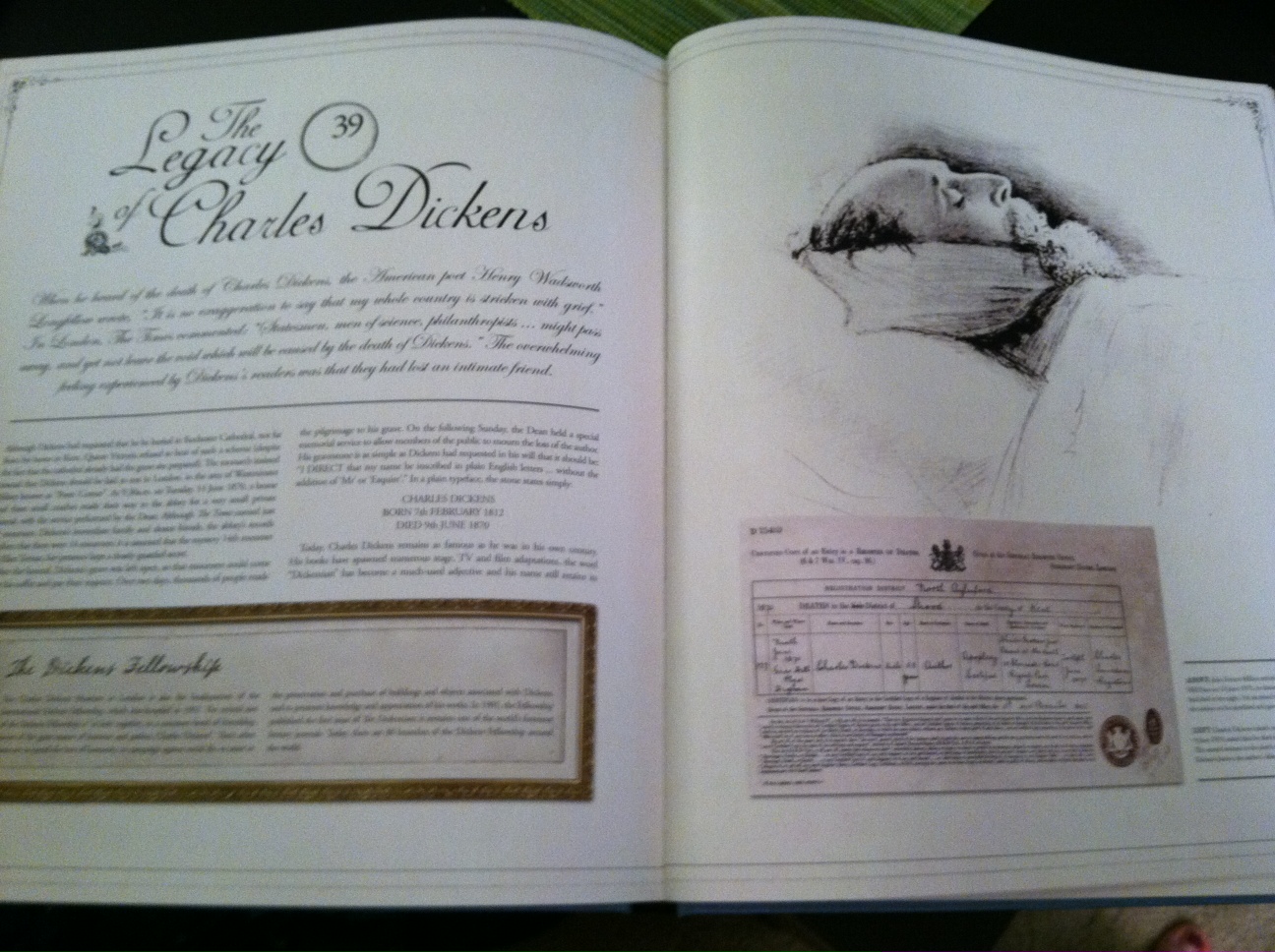
The book has a LOT of material. There is a section for each of his major novels, as well as the issues and events that took place in his lifetime. This picture shows the table of contents and the beginning of the introduction.


It begins with talking about his childhood and early years. Each section is reviewed in the italics before diving into the detail-complete with pictures!


What makes this book are the pages with INSERTS. Below you can see the first of these sections. The page on the right-hand side folds out!


For each of these little packets, there is a table of contents to tell you what is included. This one has copies of some of the manuscripts of his novels (Pickwick Papers and Oliver Twist).


And here are the inserts from the first section! You can see the pieces of manuscript (Dickens had horrible penmanship). All of these inserts come from the Dickens museum and were copied from the real thing! I also love that the front one (the orange Oliver Twist booklet) opens and is a replica of the play book!


I love that there is a feature on each of his major novels. The sections give a lot of great background information on when and where and how the novels were written. There are pictures of early editions too!


What makes this book is the emphasis on all aspects of Dickens life. In addition to sections about the social activism in which Dickens partook, there are also sections on other aspects of his life-his book tours, speeches, love interests, and the magazines that propelled him to super stardom in the 1800s.


The overall effect is a book full of wonderful information about the life and legacy of one of the world's greatest authors. Dickens did a lot for literature and this book highlights every aspect of that life!


Happy Birthday Charles!


You can find a copy of this one at any major bookstore! I first spotted it at my local Barnes and Noble. I'm sure that with his birthday celebrations this month there are tons of other Dickens themed books being highlighted in bookstores. Let me know if there is another great Dickens book I need to check out or add to my TBR list!

Friday, December 23, 2011

A Christmas Carol by Charles Dickens.

“There is nothing in the world so irresistibly contagious as laughter and good humor.”

I was feeling a bit restless the other night, so instead of starting another classic from my list and being bogged down by obligation, I took my copy of A Christmas Carol and Other Christmas Writings by Charles Dickens off the shelf. The beautiful white book had been sitting there all year, neglected and lonely. And it wasn't that I was planning on reading Christmas stories this holiday season...but I felt I needed to.

It is easy to get caught up in the bustle around the holidays-obligations, gifts, seeing family, traveling, baking, putting up decorations, etc. So, I sat down with my book of Dickens Christmas stories, had my tree lighting up the page, and read. And while I could talk about the other stories in this volume, it is the title volume that deserves the most attention. Yes, A Christmas Carol deserves all the praise.

I haven't read the story in a really long time. Instead, I have contented myself with watching the various film adaptations over the years. Last year, in fact, I watched "A Mickey's Christmas Carol" with my sister-it took us back to our childhood.

I was surprised by how moved I became by the story. The story is one we are all familiar with-learning that we need to maintain holiday spirit throughout the year, spreading joy, love, and happiness to everyone around us. But the story is so much more powerful on paper than it is in film. Because not only does the reader get this message about holiday spirit, the reader also learns a bit about what it means to be human.

“I wear the chain I forged in life....I made it link by link, and yard by yard; I girded it on of my own free will, and of my own free will I wore it.”

I was moved by Jacob Marley's account of his punishment and how it was too late to change the course of his life. And what I think fails to come across in the film versions of this story is the power of that knowledge.

I mean, we all go through like making choices about what is most important to us, what we find value in, and sometimes, with selfishness. We want and need things, pushing aside relationships and feelings with others. And I think, what Dickens was trying to say here, in addition to all the holiday cheer, is that we need to acknowledge the way we live on a daily basis.

Because yes, it is easy to be charitable and loving and helpful around the holidays. It is when we dredge on into winter, into summer, that we forget the spirit and magic of the holidays, and we start to forget that people need our help year round.

That's what I loved on this read of A Christmas Carol-that depth that you can pull from Scrooge's character as he sees those he has let down and the true consequences of his actions. It was inspiring, moving, and just what I needed this holiday season.

While you can certainly get the message by watching one of the films, nothing can beat the power and magic of Dickens' words. Reading as Scrooge transformed from a selfish and miserly sort into a man who found joy in helping those around him, and taking pleasure in spending time with them...well, it is what the holidays are all about. Dickens brought his character to life, and the transformation Scrooge undergoes in print is moving.

I think that in the future this will be a holiday favorite. I can't wait to sit around the tree and read it to my children-teaching them that we should keep the holiday spirit the whole year, not just in the month of December.

“And it was always said of him, that he knew how to keep Christmas well, if any man alive possessed the knowledge. May that be truly said of us, and all of us! And so, as Tiny Tim observed, God bless Us, Every One!”

Tuesday, May 17, 2011

Classics Circuit Dueling Authors Tour: Hard Times by Charles Dickens

Welcome to A Literary Odyssey for the Classics Circuit Tour of the dueling authors! If you are unfamiliar with the Classics Circuit and this particular tour, the Classics Circuit hosts tours of various classic authors on different blogs. On particular days, bloggers write posts on the featured author and one of their works.

What makes this tour so fascinating is that we are focusing on two authors and having a mini-duel of sorts. It is Dickens vs. Austen, and I know that I am interested to see who wins.

For those of you familiar with my blog, you might be surprised by the fact that I chose Dickens over Austen as my featured author. I view Dickens as my arch-nemesis in the literary world, and Austen as a great friend of mine, but I really wanted to push myself into reading something I was not so excited about.

Looking at titles by Dickens I have yet to read (and their length), I decided on Hard Times, a novel that defeated me back in college. It was the ONLY novel I was assigned in college that I didn’t read (thankfully, on the exam I was allowed to write about one of the other choices we read in class, so I wasn’t penalized). Back then, I read the first three pages and gave up.

My rivalry with Dickens has lasted from even earlier-to the ninth grade when I had to read Great Expectations. I hated it then, and I hated it in the fall of 2009 when I read it as Book #10 for my project list. The only other Dickens novels I have read include Oliver Twist (which I really came to LOVE) and Bleak House (which made me hate Dickens all the more). I am in a dead heat in whether I love or hate him, and I viewed Hard Times as the make it or break it. If I hated it, the score would be 3-1, and I would be tempted to give Dickens up for good. But if I loved it, well, Dickens would have another go round with ME before I considered our duel over.

Turns out, I loved it. As I began reading, I couldn’t remember what it was about the first three pages that made me so despise it in college. From the beginning this time, I was enthralled in Dickens’ world. I loved these opening lines,

“Now, what I want is, Facts. Teach these boys and girls nothing but Facts. Facts alone are wanted in life. Plant nothing else, and root out everything else. You can only form the minds of reasoning animals upon Facts; nothing else will ever be of service to them."

The story moves steadily from there. We are introduced to two distinguished gentlemen-Mr. Gradgrind and Mr. Bounderby (I should mention that whenever I read his name I pictured a giant rabbit bounding around. It kept me very amused). I love Dickens’ description of Mr. Bounderby as well,

"A year or two younger than his eminently practical friend, Mr. Bounderby looked older; his seven or eight and forty might have had the seven or eight added to it again, without surprising anybody. He had not much hair. One might have fancied he had talked it off; and that what was left, all standing up in disorder, was in that condition from being constantly blown about by his windy boastfulness."

Both of these men truly believe that children shouldn’t learn to use their imagination and should only be taught the truth. To think beyond, to imagine, would be false and unapproved.

Mr. Gradgrind’s children, however, are truly the stars of the novel. On one hand you have Tom, a seemingly put-together kind of individual who appears to be following in his father’s footsteps. There is also the lovely Louisa, a girl who does her father’s bidding to make him happy. This scene truly touched me and really captures the sense of despair I sensed in Louisa throughout the novel,

“Confining yourself rigidly to Fact, the question of Fact you state to yourself is: Does Mr. Bounderby as me to marry him? Yes, he does. The sole remaining question then is: Shall I marry him? I think nothing can be plainer than that?”

I love Louisa’s sense of despair, and it slowly worsens throughout the novel. But Tom, who seemed to upright and outstanding-sticking solidly to Fact in the beginning, also has a slow spiral downward.

The resulting conclusion is one that truly made me appreciate Dickens’ skill in storycrafting.

So yes, I loved this little novel of Dickens (the length was perfect-any longer and I probably would have struggled more than I did). The contrasts to the working class, the characters of Stephen Blackpool and Rachael, the descent of Tom into stupidity, and yes, the obnoxious Mr. Bounderby all made this novel come alive. It was a pleasure to read and has pushed me to continue trying Dickens’ novels.

Who knows, perhaps he will eventually become an author I can say I like. :)

Please make sure you check out some of the other stops for this Classics Circuit Tour! Lots of wonderful things to read!

Sunday, February 27, 2011

Oliver Twist Readalong Post 3: Volume 3.

Welcome to the third and final post for the readalong of Charles Dickens' Oliver Twist hosted here at A Literary Odyssey. I, for one, had a great time reading through everyone's posts the last two times we posts. You can go here to see our thoughts over part 1, and here for our thoughts on part 2.

I would like to say from the beginning that when I finished, I didn't want to jump for joy because I conquered Dickens. I also didn't call him names, or throw the book at the wall, or even start a rant aimed in my poor husband's general direction about how I hate Dickens. Nope, my husband and cats didn't hear any grumbling.

Instead, Matt had to listen to me ramble about how perhaps I had misjudged Dickens in the past and how he wasn't all bad. Matt was playing Call of Duty at the time, so I doubt he actually listened to me.

The point is, I finished this one and liked it. I liked the story, I understood what Dickens was trying to accomplish, and I didn't leave it wanting to kill him. This is a big deal you guys. Like major.

What this tells me is that I should never hold grudges against authors I "don't like." Because they can surprise you. It only takes one book. This is the one book that has me willing to give Dickens another try, and another. And since I still have 4 novels by him on my list, this is probably a good thing. Perhaps by going into them, remembering that I liked this one, I might be willing to set my irritation over his wordiness aside.

Okay, enough about that and on to the novel!

This third portion picks up where the second left off. We meet up with the skeazy character of Monks, who is meeting them Bumbles for a private conversation. We learn a few more details about the death of Oliver's mother, and we get some hazy information regarding who Oliver is. A mysterious bundle is dropped into a roaring pit, destroying any and all evidence of who Oliver is.

The story moves back towards Fagin (the character who is constantly referred to as "the Jew") and we soon learn that Monks also knows Fagin. Together, the are scheming evil men who had a plot for destroying Oliver. We also go back to learn more about Nancy and Sikes. Some very nasty things occur which take up the bulk of this ending section. I don't want to go into detail to ruin it for anyone who hasn't read the novel, but I loved the action and power of this last section. There was a lot of drama, and as a reader, I could tell that Dickens was trying to shock his readers a bit.

Eventually we learn a little more about Oliver and his rescuers (the lovely people who have taken him in) begin to investigate his past. Things begin to unfold and we soon learn who Monks is, as well as who Oliver is and the truth about his parentage. It all wrapped up neatly, with the bad guys getting their due and young Oliver learning the truth about his identity.

And even though the novel wrapped up nicely, it was certainly dark beneath the layer of sarcasm and humor. It paints a very seedy picture of society at the time and of the poor's plight. You have to feel for the workers in the workhouses, and you feel for the young boys under Fagin's influence. With no real parents to instruct them or care for them, what other choice do they have but to go bad?

I also felt this last section moved along much quicker than the first 2/3 of the book. Perhaps it was the action and drama, but I found myself a little more invested in what was happening with the nasty characters, whereas before I just wanted to focus on Oliver. I love how Dickens wound all the small little bits and pieces together to form a coherent ending. I suppose that is a strength of his-that all these side plots do wind up meaning something. But it was less obnoxious this time and well done.

My only big problem with the entire novel is the labeling of Fagin as "the Jew" and the antisemitism towards his character. Normally I can tolerate racism in a novel-it captures the essence of the novel and adds to the overall meaning-but I was irritated that Fagin was mainly called "the Jew." Why even bother to give him a name then? It annoyed me and I grew slightly exasperated at the repetition.

But for that being my only critique, you can see why I walked away from this one with a renewed faith in Mr. Dickens. I was happy to see that I can enjoy a Dickens novel and get something. Bravo Charles, BRAVO.


If you have completed your post for this readalong, please comment and leave a link to your post so I can link it here.

In addition, please leave an e-mail address for me so I can contact you. I have "something" for all the participants of my readalong, and I can't talk about it with you until I have a way to contact you! (January participants-you'll be getting an e-mail as well. I figured sending them out every two months as opposed to every month would make my life easier).

Katy F.
Kristi
Zoe
Bookworm1858
Darlyn
Adam
L.L.
tasseled

Saturday, February 19, 2011

Outta the Rut Readathon Post 2:

Well, I am back to check in once more.

Let's just say that I am not being very productive. Shortly after writing my other post (at about 1:30 this afternoon), I got distracted. The first thing I needed to do was upload all 17 of my new books into my Excel file (they're all cataloged there). Once that was done, I needed to find room for them on my shelves.

That was a task. Since I have all my classics alphabetized, I had to move a lot of books around to get them in the right spots. Then I had a slight panic attack when I thought they might not all fit. But rest assured, they all found a home eventually.

And of course, I needed to find a million other little things to do around the apartment before settling down with my book (Oliver Twist). I was interrupted a little later by the husband coming home from work. I had to go shower (he made me get out of my comfy clothes) since he was taking me out to dinner. We just got home a little while ago. It is almost 8:30 and I have only read 100 pages today.

So, today=fail. But now that we're home and he is glued to his Xbox, I am going to spend some time with Oliver Twist. I only have 40 more pages until I am finished. That should only take me 30 minutes or so. That is completely doable.

I'm not sure what to read after that. I want something that'll grab me, something short so I can finish it and feel accomplished, and something that I'll love. Any ideas? I am determined to turn this crappy reading day into a success. And if I can finish Oliver Twist and another short title, I can call it that.

Thursday, February 17, 2011

Oliver Twist Readalong Post 2: Volume 2.

Welcome to the second post (of three) for Charles Dickens' Oliver Twist. Participants made their first post earlier this month. We only have one more post to go to have conquered this early piece of Dickens' writing.

On to the second volume! I should warn you there may be slight spoilers, but nothing major.

I need to be quite honest: I am really enjoying this novel. I have been captured by the story. I want to solve the mystery of Oliver's birth, see Fagin go down, and get the satisfaction of a somewhat happy ending.

In this volume, we pick up where we left off. Oliver, a pawn of the evil Fagin, was left behind after being shot during the failed robbery. Left in a ditch, Oliver finds his way to the nearest house in hopes of finding help. Just so happens that he arrives at the same house he was sent to rob.

The people, Mrs. Maylie and Rose, who live there, take pity on the wounded Oliver and begin to nurse him back to health. You can tell that they sincerely feel for Oliver as he confides his story to them in detail. He finally begins to feel safe here, and happy.

We also get introduced to Mrs. Maylie's son, Harry, who just so happens to love Rose. He wants to marry her, but because of mysterious circumstances surrounding her birth, she is not as socially "high" as dear Harry. I foresee some connection to Oliver's own mysterious beginnings.

There are also a few scenes with Mr. Bumble-one of those men who ran the workhouse where Oliver was born. He is approached at the very end of this volume by a mysterious man who wants information about the nurse who was there when Oliver was born. All we really know is that his name is Monks.

Insanity.

I am completely suckered in and I am so glad I don't know where this story is headed. Dickens is surprising me. I was convinced I was going to hate this as much as his other work before I began, and while he does drag on a bit, I don't find this to be even in the same league as the other novels I've read. Because while he is certainly touching on some deep and serious topics, he does make some light of them. You don't HAVE to feel the seriousness unless you want to. But it is there, and worthy of discussing once you finish. :)

Anyway, I am looking forward to getting some answers and seeing how everything turns out in the end.

If you finished this section, please leave me a link to your post so I can link it up here! Then share and participate and discuss this to your heart's content! ;)

Bookworm1858

Tuesday, February 8, 2011

Oliver Twist Readalong Post 1: Volume 1 (Ch. 1-22).

Welcome to the first post (of three) for the Oliver Twist readalong hosted here at A Literary Odyssey.

If you have been around and reading my posts for any length of time, you have probably noticed that I am not the biggest fan of Mr. Charles Dickens. I blame it on a first horrible experience with Great Expectations, ninth grade English, and my unwillingness to read the novel.

Since then, I have given Dickens a few more chances. I "read" part of Hard Times in college and hated it. I read A Christmas Carol and the only saving grace was the fact that it was a story I knew well before going into it. I reread Great Expectations as book #10 in this project of mine (and still hated it), and recently participated in a readalong of Bleak House and guess what, hated it.

So Dickens and I meet again. And I am glad that I have so many of you along for the ride. And if you were coming here, expecting to hear me rant and rave about the atrocities of Mr. Dickens once more, well...

You were wrong.

I actually kind of like Oliver Twist. It shocked me too. But from the beginning, this was a story that captured my attention and drew me in. Perhaps it is the tone the narrator takes from the very beginning;

"Among other public buildings in a certain town, which for many reasons it will be prudent to refrain from mentioning, and to which I will assign no fictitious name, there is one anciently common to most towns, great or small: to wit, a workhouse; and in this workhouse was born; on a day and date which I need not trouble myself to repeat, inasmuch as it can be of no possible consequence to the reader, in this stage of the business at all events; the item of mortality whose name is prefixed to the head of this chapter," (3).

I love the tone and the feeling of despair that I get as the reader. After reading this (lengthy-it IS Dickens), I knew that I was going to be captivated by the story. While unhappy and sober, I am captivated by it. I want to know what happens to poor Oliver Twist.

The first section of the book (of 3), introduces us to Oliver and takes us through the beginnings of his miserable little life. He is orphaned as an infant, his mother dying shortly after giving birth to him, and spends the beginning few years of his life under the care of a horrible woman.

After a certain time, he taken to a workhouse. It is here that we have that famous line;

"Please, sir, I want some more," (15).

We watch as Oliver is humiliated for asking for more food, estranged from the other boys, and determined to be a horrible example of a human being. He is degraded, called names, and seen as worthless by the men in charge of the workhouse.

He is misunderstood and craving love and care. Of course, being an orphan, poor, and homeless, Oliver is not deserving of love and care from anyone. After all, who would care for a young boy?

I know that Dickens purpose in many of his novels is showing the plight of the poor, and that is evident in the treatment of Oliver and the other poor characters we encounter. It enrages me now to know that people were treated this way. In some areas, prejudices like this still occur. It saddens me, to know that a young boy can be so misunderstood because his stomach is still growling and deemed a troublemaker.

Oliver eventually escapes (I cheered), only to find himself in the hands of a man and his group of young, pick-pocketing boys. They take Oliver in and we watch as Oliver misunderstands what they want of him. Again, I felt awful reading about Oliver's naivety regarding crime and life on the street. I rooted for him when he was taken in and cared for, but of course, that nasty man found him and brought him back.

Speaking of that man, he is always referred to as "the Jew," or something more derogatory. At first I wasn't offended, thinking Dickens was just trying to tell us more about him, but after he is repeatedly referred to in that way, I started to get annoyed. Can we please just call him by his name Dickens?

The first section ends shortly after Oliver finds himself back in this lair of thieves. When I finished, I found myself thinking how fast the 180 pages flew by, and how much Dickens seemed to cram into those pages.

I find this novel, and the writing style, to be far different from my other experiences with Dickens. While at times some of the writing is still a little much for me, I didn't find it as offensive as I did in some other novels (*ahem* Bleak House). The story also seems fairly straight forward...and simpler in some way. It is deceptive in that way. As a reader, you think you are only learning about Oliver's life from an offhanded and uncaring perspective, but you can see where Dickens is trying to subtly draw our attention-like to the conditions in the workhouse. Very clever Charles, very clever.

But I come away from the first section wanting to read more and not wanting to bash my head in. That is a huge improvement from my previous experiences. Let us hope that Charles doesn't disappoint me.

What did you think? For those of you who have read things by Dickens other than Oliver Twist, do you find that there is a difference in style?

For those participating in the readalong, please comment below and leave a link to your post. I will link it here so that others can find your thoughts and comment.

The second post on the next 14 chapters is scheduled for the 17th. See you then!

Stacy
Darlyn
Katy F.
Kristi
Bookworm1858
L.L.
tasseled
fleurfisher

Saturday, January 29, 2011

Oliver Twist Readalong UPDATE.

I am hoping that those of you who are participating in the Oliver Twist Readalong see this message.

Apparently I am an idiot and messed up the dates on the original sign-up post. When I was trying to figure out the specific dates for posting on each section, I was looking at two different calendars for February...one for 2011 and one for 2010.

Zoe brought it to my attention that the dates and the days didn't match up.

With all that being said, I went back and changed the dates of the posts. Remember, we are doing three posts since there are three "books" in this novel. Here are the dates:
  • Post 1 will go up on February 8th (Tuesday) and will cover Book 1 (roughly 180 pages-the longest section)
  • Post 2 will go up on February 17th (Thursday) and will cover Book 2 (roughly 120 pages)
  • Post 3 will go up on February 28th (Monday) and will cover Book 3 (roughly 140 pages)
The dates have also been changed on the original post and for those of you who are still interested in joining us, you can sign up there.

I have also heard from a couple participants that their editions don't have the divisions of books. The first book has 22 chapters, the second has 14, and the third has 15. I hope that helps!

Please pass the word along to any people you know are participating.

Thanks for understanding my error!